


Call us now
08045813359
Flat Bottom Flask
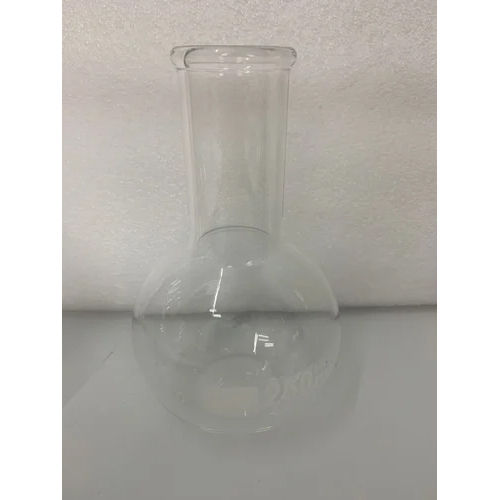

Flat Bottom Flask Specification
- Features
- High-quality
- Shape
- Round
- Power Supply
- Manual
- Usage
- Chemical Laboratory
- Size
- Standard
- Product Type
- Flat Bottom Flask
- Color
- Transparent
- Material
- Borosilicate Glass
Flat Bottom Flask Trade Information
- Minimum Order Quantity
- 1000 Pieces
- Supply Ability
- 5000 Pieces Per Month
- Delivery Time
- 7 Days
About Flat Bottom Flask
A flat-bottom flask is a stable, versatile lab container, typically made of heat-resistant borosilicate glass, featuring a wide flat base for standing on surfaces and a cylindrical neck for adding stoppers or apparatus, used for mixing, heating, boiling, storage, and basic chemical reactions like titrations, though its flat bottom can cause uneven heating compared to round-bottom flasks.
Key Features:
- Shape: Spherical or round body with a flat bottom and a narrow or wide neck.
- Material: Usually borosilicate glass (Borosilicate 3.3) for chemical and thermal resistance.
- Stability: The flat base allows it to sit securely on a bench or hotplate without a stand.
Common Uses:
- Storage: Holding liquids, reagents, or solutions.
- Heating: Gentle heating, boiling, and evaporation due to stability.
- Mixing: Ideal for mixing and swirling liquids.
- Reactions: Suitable for simple chemical synthesis and titrations.
- Distillation: Used with condensers for distillation setups.
Advantages:
- Stable: Stands on its own, unlike round-bottom flasks.
- Versatile: Good for a range of general lab tasks.
- Reduced Evaporation: Narrow neck minimizes loss of volatile substances.
Tell us about your requirement

Price:
Quantity
Select Unit
- 50
- 100
- 200
- 250
- 500
- 1000+
Additional detail
Mobile number
Email


Borosilico Life Sciences Private Limited
GST : 06AAMCB0690A1Z1
GST : 06AAMCB0690A1Z1
B No. 322, New Shalimar Bagh, Behind B D Flour,Ambala - 133001, Haryana, India
Phone :08045813359
 Send Inquiry
 Send Inquiry
 Send SMS
 Call Me Free
Borosilico Life Sciences Private Limited
All Rights Reserved.(Terms of Use)
Developed and Managed by Infocom Network Private Limited.
Developed and Managed by Infocom Network Private Limited.

